
This journal started in February 2023 with a narrow question: what does an H13 grade actually mean? Twenty articles later, the category has changed more than any single product in it. Here is where we think the honest ground now sits.
What became measurable
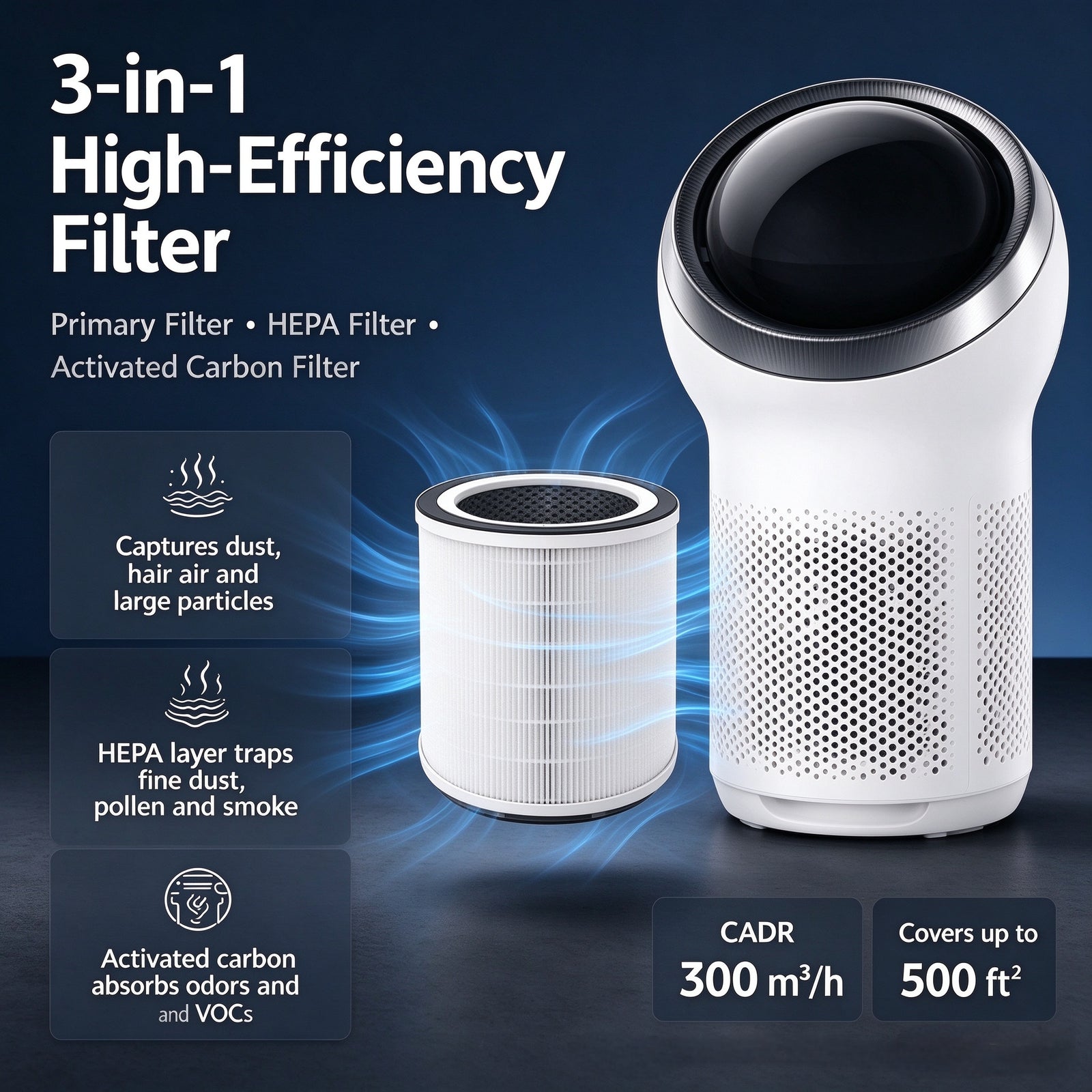
- CADR and ACH are now routinely published alongside efficiency percentages, and consumers increasingly ask for them.
- Zero-ozone and CARB / UL 867 references moved from a niche concern to a standard line on serious spec sheets.
- Sensor limitations are openly discussed; a PM2.5 number is widely understood as a trend rather than a laboratory result.
- Filter-life estimation has moved from a calendar to an exposure-weighted model on better products.
What is still murky
Gas-phase performance remains the weakest part of consumer specification. There is still no widely adopted, affordable equivalent of CADR for formaldehyde or TVOC, which means carbon layer mass, dwell time and saturation behaviour are largely invisible to the buyer. Coverage claims also remain inconsistent between manufacturers, and terms like active air treatment still blur mechanical filtration with ionisation.
We would like to see a standard gas-phase challenge test and a mandatory statement of consumable cost per year - the number that actually determines whether a purifier stays in use after the first cartridge.
Three directions we are watching
- Selective solid-state gas sensing, as discussed in March 2026, finally giving the carbon stage a feedback loop.
- On-device prediction that anticipates pollution events without exporting household behaviour to a cloud.
- Material circularity: mono-material cartridges, standardised geometry and retail take-back at real scale.
What has not changed for us
Our 2019 product principle is still the whole strategy: purify the air, and nothing else. Physical H13 filtration, zero ozone output, honest CADR, a sleep mode quiet enough to forget, filters priced so people replace them, and a real company address published on every page. Eight models now cover desks, bedrooms, living rooms, cars and dry winter air - but the rule has not been renegotiated.
A brand is not a logo or a story. It is the set of decisions you refuse to reverse when a shortcut would be cheaper.
Thank you for reading
If you have a question about any of the twenty articles in this journal - about HEPA grades, ozone, acoustics, sensors or filter waste - write to invitop01@gmail.com. Our engineers read it. The next three years will presumably give us another twenty things to be precise about.