
Sustainability claims in small appliances tend to focus on packaging. The larger, recurring waste stream is the filter cartridge: a plastic frame, a fibre mat, a carbon layer and an elastomer gasket, replaced once or twice a year for the life of the machine.
Why a used filter is hard to recycle
It is a composite bonded for the very good reason that layers must not separate in use. Adhesives, melt-blown synthetics and mixed elastomers make mechanical separation uneconomic, and the media is contaminated with captured particulate by definition. Most used cartridges today go to residual waste or incineration.
Four design levers that help
- Mono-material frames: one polymer type, marked, with snap-fit rather than glued joints so media can be separated at end of life.
- Standardised cartridge geometry across models, so a take-back stream has volume and a single handling process.
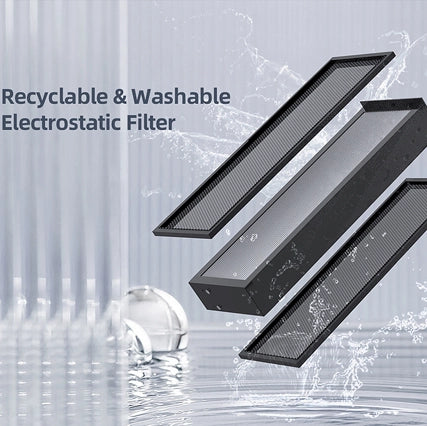
- A washable pre-filter that removes the coarse load, extending the life of the consumable stage - the approach we wrote about in 2024.
- Replacement pricing low enough that people replace on time rather than over-running a clogged filter and discarding the whole unit.
Take-back is a logistics problem
Collecting a used filter from a household costs more than the material recovered. The realistic model is consolidation: return with the next filter order, aggregated through retail partners, then processed in bulk. Our Where to Buy network of independent electrical retailers is a natural collection point, because those stores already handle small-appliance returns and have a relationship with the customer.
Circularity is won in the parts list and the returns envelope - not in a headline on the box.
Where we are, honestly
As of 2026 our frames are a single marked polymer, our cartridge geometry is shared across six of eight models, and a take-back pilot is running with selected European retail partners. We have not eliminated the consumable stage, and we do not claim a fully circular product. Publishing the gap is part of the work: the promise we made in 2011 was to be straightforward about what a machine can and cannot do.