
Reactive auto mode has a built-in delay: the sensor must see pollution before the fan responds. By the time the number climbs, the first minutes of a cooking or cleaning event have already happened. Anticipatory control tries to close that gap.
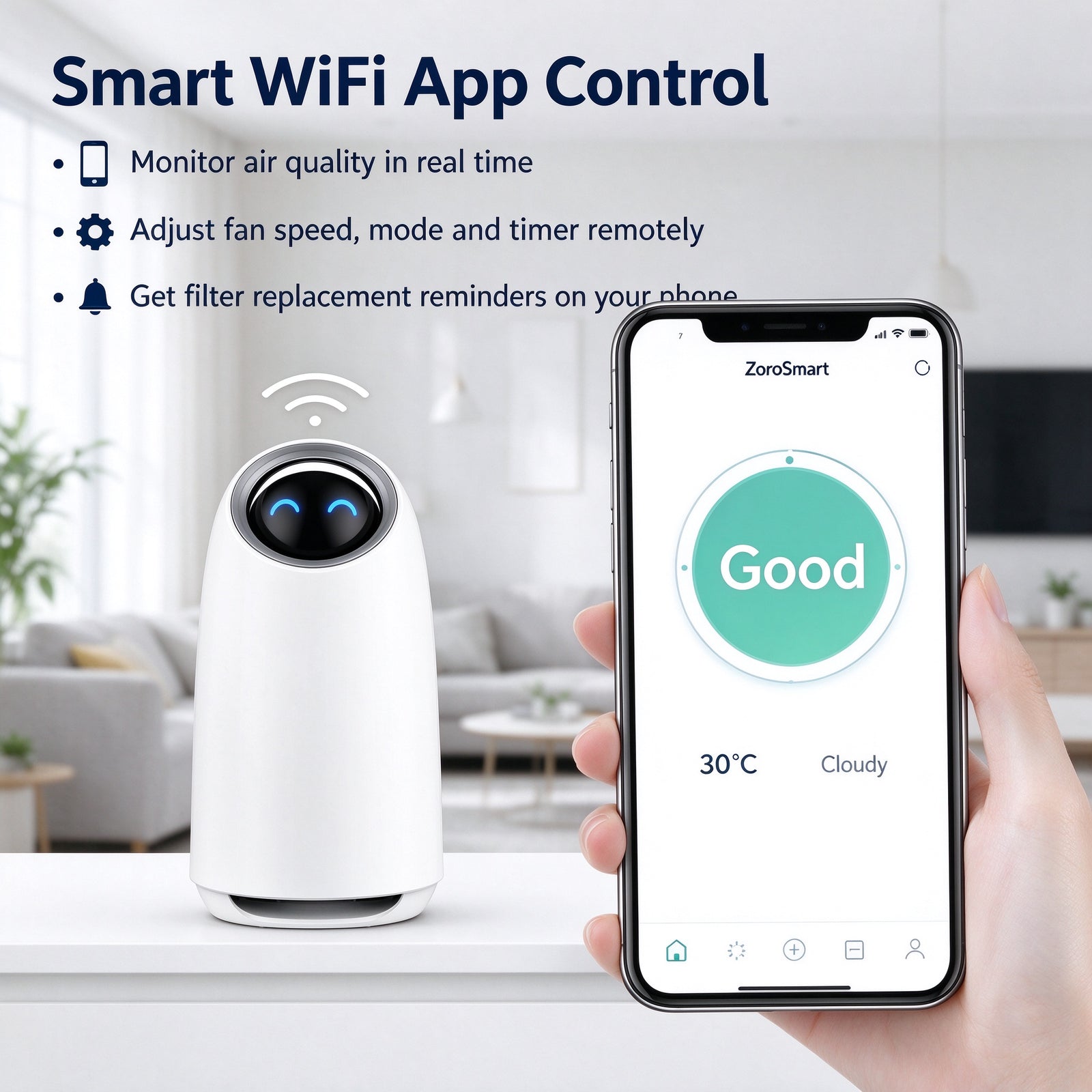
What can be learned locally
A purifier sees a remarkably regular signal: time of day, day of week, fan step, sensor trend, humidity, and the state of any connected schedule. Cooking peaks, vacuuming, a dog coming back from a walk and the evening heating cycle all have signatures. A small model - a few kilobytes of parameters, running on the existing microcontroller - can learn the pattern of a specific home without sending a single byte of behavioural data to a server.
This is the important distinction from cloud AI. The data never leaves the device, latency is zero, and the feature keeps working when the internet does not. There is no conversational interface and no need for one.
From prediction to action
- Pre-emptive boost: start a gentle ramp a few minutes before the usual cooking peak, avoiding an abrupt noise change.
- Adaptive hysteresis: widen or narrow the fan-switching thresholds depending on how quickly the room normally recovers.
- Night guard: suppress unnecessary speed changes during learned sleep hours unless the reading is genuinely high.
- Filter forecast: combine predicted exposure with the loading model described in our November 2025 article.
The failure modes we design against
A model that learns the wrong lesson is worse than no model. We keep a hard reactive layer above the prediction, so an unexpected smoke event always overrides the schedule immediately. Predictions are capped to modest speed changes, never to maximum fan. The first two weeks after setup are observation-only, and any user override is treated as a strong correction signal.
The best intelligence in an appliance is invisible: the room is simply clean, and you never heard the fan decide anything.
Where we are in 2026
Predictive boost and night guard are in field trials on OLED-equipped models; a manual toggle keeps them optional. We are publishing the behaviour openly rather than as a magic AI badge, because a feature you cannot understand is a feature you cannot trust in your bedroom.