
New furniture, engineered wood, adhesives, paints and sealants release volatile compounds for months - in some cases years. Understanding the shape of that release curve is more useful than any single air-quality reading.
Emission is a decaying curve, not an event
Most pressed-wood products show a high initial emission that falls steeply over the first weeks, then a long, low tail that can persist for many months. Formaldehyde is particularly persistent because it is generated by the slow hydrolysis of urea-formaldehyde resins inside the board, not just by surface residue. The reservoir is the material itself.
Two variables dominate: temperature and humidity. Emission rates rise noticeably with both, which is why a freshly renovated flat can smell fine in a cool spring and become obvious in its first heated or humid summer. Ventilation dilutes; it does not remove the source.
A realistic first-year plan
- Weeks 1-8: ventilate daily with cross-draught, keep the purifier running continuously on auto, and expect the carbon layer to load quickly.
- Months 3-6: move to a scheduled boost around cooking and cleaning, with continuous low-speed background operation.
- Months 6-12: replace the composite cartridge at the short end of its life; reassess with a calibrated instrument if the smell returns in warm weather.
- Always: control the source where possible - seal exposed board edges, choose low-emission materials at purchase.
Why filter replacement timing matters here
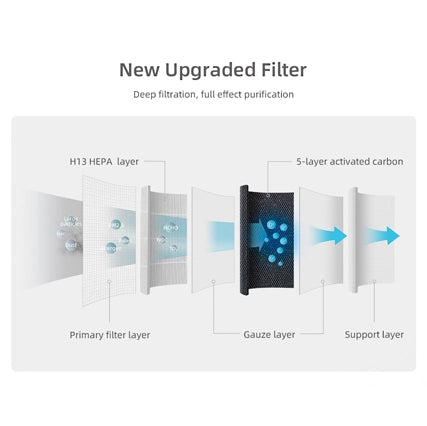
A saturated carbon layer does not announce itself. There is no colour change and no drop in airflow, because the mechanical H13 media is still doing its job on particles. This is exactly why our filter-life estimate uses cumulative sensor load in addition to runtime: a home with elevated TVOC exposure should be reminded sooner than one with clean outdoor air.
Off-gassing is a marathon. The purifier's job is to keep the concentration low while the materials slowly finish talking.
What we tell customers
Be sceptical of a single miracle reading, avoid ozone-generating devices (ozone reacts with VOCs and can create additional aldehydes), and do not rely on a low-cost VOC index as a health measurement. For peace of mind after a major renovation, hire an accredited indoor-air test. Use the purifier to keep day-to-day levels down between measurements.