
Filter waste is the quiet environmental cost of clean air. A typical purifier sends one or two plastic-framed cartridges to landfill every year. Reducing that without reducing performance is a design problem we have been working on since 2022.
Split the job into two
Coarse particles - hair, lint, large dust, pollen grains - are volumetrically the biggest load on a filter and the easiest to catch. Fine particles near 0.3 microns need dense mechanical media. If you ask one disposable mat to do both, it clogs on the coarse fraction long before the fine media is exhausted.
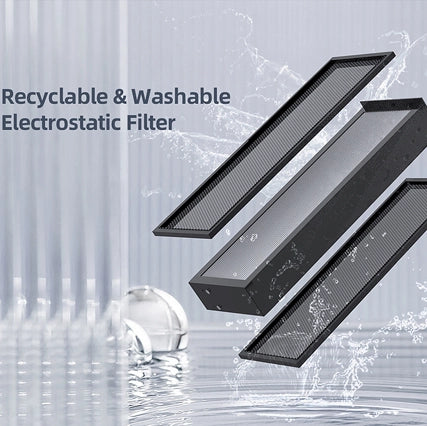
A washable electrostatic pre-filter takes the coarse load. Manufactured with a permanent electrostatic charge, it captures particles on a coarse, open structure that can be rinsed under a tap and reused for years. The H13 cartridge behind it then degrades only on the fine fraction and lasts closer to the full 6-12 months.
The trade-offs, stated plainly
- Charged media loses some efficiency when wet or coated with oily cooking aerosol; rinsing restores most of it, but not forever.
- A pre-filter adds a small pressure drop and a cleaning step the owner must remember.
- It does not replace the H13 cartridge - fine particles and gases still need a consumable stage.
- The environmental gain depends on real behaviour: a washable layer nobody washes is just extra plastic.
Designing for the behaviour we actually see
We made the pre-filter visible from the top of the unit, tool-free to lift out, and paired it with a filter-life indicator based on cumulative runtime and sensor load rather than a fixed calendar. The reminder appears in the app and on the OLED display. A rinse every four to six weeks is realistic; a complicated disassembly procedure is not.
Sustainability in appliances is mostly about whether the maintenance step is easy enough to actually happen.
What we are not claiming
Our cartridges are not yet fully compostable, and we will not call a product circular because one layer is washable. We reduced cartridge mass, standardised the frame across models so a single SKU serves several units, and keep replacement filters priced low enough that people replace them on time. Incremental, measurable, and honest - that is the 2024 baseline we are building from.